Which Painter Is Most Closely Associated With the Neoclassical Movement in Art?
Neoclassicism
Neoclassicism refers to movements in the arts that describe inspiration from the "classical" fine art and civilization of aboriginal Greece and Rome.
Learning Objectives
Identify attributes of Neoclassicism and some of its key figures
Key Takeaways
Cardinal Points
- The height of Neoclassicism coincided with the 18th century Enlightenment era, and continued into the early 19th century.
- With the increasing popularity of the Grand Tour, it became fashionable to collect antiquities as souvenirs, which spread the Neoclassical style through Europe and America.
- Neoclassicism spanned all of the arts including painting, sculpture, the decorative arts, theatre, literature, music, and architecture.
- Generally speaking, Neoclassicism is defined stylistically by its employ of direct lines, minimal use of colour, simplicity of class and, of form, an adherence to classical values and techniques.
- Rococo, with its emphasis on disproportion, bright colors, and ornamentation is typically considered to be the directly opposite of the Neoclassical way.
Central Terms
- Thou Tour: The traditional tour of Europe undertaken by mainly upper-class European young men of means. The custom flourished from about 1660 until the appearance of large-calibration rail transit in the 1840s.
- Enlightenment: A concept in spirituality, philosophy, and psychology related to achieving clarity of perception, reason, and cognition.
- Rococo: A style of baroque architecture and decorative art, from 18th century French republic, having elaborate ornamentation.
The classical revival, likewise known as Neoclassicism, refers to movements in the arts that describe inspiration from the "classical" art and civilisation of ancient Hellenic republic and Rome. The height of Neoclassicism coincided with the 18th century Enlightenment era, and continued into the early 19th century. The ascendant styles during the 18th century were Bizarre and Rococo. The latter, with its emphasis on asymmetry, bright colors, and ornamentation is typically considered to be the straight opposite of the Neoclassical style, which is based on club, symmetry, and simplicity. With the increasing popularity of the Thou Bout, it became stylish to collect antiquities as souvenirs. This tradition of collecting laid the foundations for many bully art collections and spread the classical revival throughout Europe and America.
Neoclassicism grew to encompass all of the arts, including painting, sculpture, the decorative arts, theatre, literature, music, and compages. The way can generally exist identified by its use of straight lines, minimal utilise of color, simplicity of class and, of form, its adherence to classical values and techniques.
In music, the menses saw the rise of classical music and in painting, the works of Jaques-Louis David became synonymous with the classical revival. However, Neoclassicism was felt most strongly in compages, sculpture, and the decorative arts, where classical models in the same medium were fairly numerous and accessible. Sculpture in particular had a great wealth of ancient models from which to acquire, however, most were Roman copies of Greek originals.

Rinaldo Rinaldi, Chirone Insegna Advertizing Achille a Suonare La Cetra : Executed in a classical style and adhering to classical themes, this sculpture is a typical example of the Neoclassical manner.
Neoclassical compages was modeled after the classical style and, as with other art forms, was in many ways a reaction against the exuberant Rococo style. The architecture of the Italian architect Andrea Palladio became very popular in the mid 18th century. Additionally, archaeological ruins establish in Pompeii and Herculaneum informed many of the stylistic values of Neoclassical interior blueprint based on the ancient Roman rediscoveries.

Villa Godi Valmarana, Lonedo di Lugo, Veneto, Italian republic: Villa Godi was i of the first works by Palladio. Its austere facade, biconvex doorways and minimal symmetry reflect his adherence to classical stylistic values.
Neoclassical Paintings
Neoclassical painting, produced past men and women, drew its inspiration from the classical fine art and civilization of aboriginal Hellenic republic and Rome.
Learning Objectives
Hash out the overarching themes nowadays in Neoclassical painting
Key Takeaways
Key Points
- Neoclassical subject area matter draws from the history and general culture of ancient Greece and Ancient Rome. It is often described equally a reaction to the lighthearted and "frivolous" subject matter of the Rococo.
- Neoclassical painting is characterized by the use of directly lines, a smooth paint surface, the depiction of light, a minimal apply of color, and the articulate, crisp definition of forms.
- The works of Jacques-Louis David are usually hailed as the epitome of Neoclassical painting.
- David attracted over 300 students to his studio, including Jean-Auguste-Dominique Ingres, Marie-Guillemine Benoist, and Angélique Mongez, the final of whom tried to extend the Neoclassical tradition beyond her instructor'southward expiry.
Fundamental Terms
- Enlightenment: A philosophical motion in 17th and 18th century Europe. Also known equally the Age of Reason, this was an era that emphasized rationalism.
Groundwork and Characteristics
Neoclassicism is the term for movements in the arts that draw inspiration from the classical art and civilisation of ancient Hellenic republic and Rome. The tiptop of Neoclassicism coincided with the 18th century Enlightenment era and continued into the early 19th century. With the advent of the M Bout—a much enjoyed trip around Europe intended to introduce young men to the extended culture and people of their world—it became fashionable to collect antiquities as souvenirs. This tradition laid the foundations of many great collections and ensured the spread of the Neoclassical revival throughout Europe and America. The French Neoclassical style would greatly contribute to the monumentalism of the French Revolution, with the accent of both lying in virtue and patriotism.
Neoclassical painting is characterized by the apply of straight lines, a smooth paint surface hiding castor work, the depiction of low-cal, a minimal use of color, and the clear, crisp definition of forms. Its subject matter ordinarily relates to either Greco-Roman history or other cultural attributes, such as allegory and virtue. The softness of pigment awarding and light-hearted and "frivolous" subject thing that narrate Rococo painting is recognized as the reverse of the Neoclassical style. The works of Jacques-Louis David are widely considered to be the paradigm of Neoclassical painting. Many painters combined aspects of Romanticism with a vaguely Neoclassical style before David'due south success, but these works did not strike whatsoever chords with audiences. Typically, the subject thing of Neoclassical painting consisted of the depiction of events from history, mythological scenes, and the architecture and ruins of ancient Rome.
The School of David
Neoclassical painting gained new momentum with the not bad success of David's Adjuration of the Horatii at the Paris Salon of 1785. The painting had been commissioned past the royal authorities and was created in a style that was the perfect combination of arcadian structure and dramatic outcome. The painting created an uproar, and David was proclaimed to take perfectly defined the Neoclassical gustation in his painting manner. He thereby became the quintessential painter of the motility. In The Oath of the Horatii, the perspective is perpendicular to the moving picture plane. It is defined past a dark arcade behind several classical heroic figures. In that location is an element of theatre, or staging, that evokes the grandeur of opera. David shortly became the leading French painter and enjoyed a great deal of government patronage. Over the course of his long career, he attracted over 300 students to his studio.

Jacques-Louis David. The Oath of the Horatii (1784): Oil on canvas. Musée du Louvre, Paris.
Jean-Auguste-Dominique Ingres, a Neoclassical painter of history and portraiture, was i of David's students. Deeply devoted to classical techniques, Ingres is known to take believed himself to exist a conservator of the style of the ancient masters, although he later on painted subjects in the Romantic style. Examples of his Neoclassical work include the paintings Virgil Reading to Augustus (1812), and Oedipus and the Sphinx (1864). Both David and Ingres fabricated use of the highly organized imagery, straight lines, and clearly defined forms that were typical of Neoclassical painting during the 18th century.
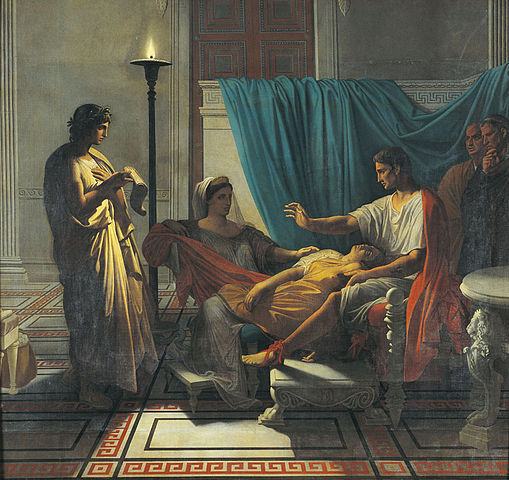
Virgil Reading to Augustus by Jean-Auguste-Dominique Ingres (1812): Oil on canvas. The Walters Art Museum.
While tradition and the rules governing the Académie Française barred women from studying from the nude model (a necessity for executing an constructive Neoclassical painting), David believed that women were capable of producing successful art of the style and welcomed many every bit his students. Among the most successful were Marie-Guillemine Benoist, who somewhen won commissions from the Bonaparte family, and Angélique Mongez, who won patrons from as far away as Russia.

Self-Portrait by Marie-Guillemine Benoist (1788): In this untraced oil on canvas, Benoist (and so Leroulx de la Ville) paints a department from David'south acclaimed Neoclassical painting of Justinian's blinded full general Belisarius begging for alms. Her render of the viewer's gaze and classical attire show her confidence as an artist and conformity to creative trends.
Mongez is all-time known for being one of the few women to paint awe-inspiring subjects that frequently included the male nude, a feat for which hostile critics oftentimes attacked her.

Theseus and Pirithoüs Clearing the World of Brigands, Deliver 2 Women from the Hands of Their Abductors by Angélique Mongez (1806): Oil on canvass. Hermitage Museum, St. Petersburg, Russia.
Mongez and Antoine-Jean Gros, another of David'south students, tried to carry on the Neoclassical tradition after David'southward death in 1825 but were unsuccessful in face up of the growing popularity of Romanticism.
Neoclassical Sculpture
A reaction confronting the "frivolity" of the Rococo, Neoclassical sculpture depicts serious subjects influenced by the ancient Greek and Roman past.
Learning Objectives
Explicate what motifs are common to Neoclassical sculpture
Key Takeaways
Key Points
- Neoclassicism emerged in the 2d half of the 18th century, following the excavations of the ruins of Pompeii, which sparked renewed interest in the Graeco-Roman earth.
- Neoclassical sculpture is defined by its symmetry, life-sized to monumental scale, and its serious subject matter.
- The subjects of Neoclassical sculpture ranged from mythological figures to heroes of the by to major gimmicky personages.
- Neoclassical sculpture could capture its discipline as either idealized or in a more veristic manner.
Key Terms
- verism: An aboriginal Roman technique, in which the subject area is depicted with "warts and all" realism.
As with painting, Neoclassicism made its way into sculpture in the second half of the 18th century. In addition to the ideals of the Enlightenment, the excavations of the ruins at Pompeii began to spark a renewed involvement in classical culture. Whereas Rococo sculpture consisted of pocket-sized-calibration asymmetrical objects focusing on themes of dearest and gaiety, neoclassical sculpture assumed life-size to awe-inspiring scale and focused on themes of heroism, patriotism, and virtue.
In his tomb sculpture, the Enlightenment philosophe Voltaire is honored in true Neoclassical grade. In a style influenced past ancient Roman verism, he appears every bit an elderly homo to accolade his wisdom. He wears a contemporary commoner's blouse to convey his humbleness, and his robe assumes the advent of an ancient Roman toga from a distance. Like his ancient predecessors, his facial expression and his torso linguistic communication suggest an air of scholarly seriousness.

Voltaire'due south tomb.: Panthéon, Paris.
Neoclassical sculptors benefited from an affluence of ancient models, admitting Roman copies of Greek bronzes in most cases. The leading Neoclassical sculptors enjoyed much acclaim during their lifetimes. One of them was Jean-Antoine Houdon, whose piece of work was mainly portraits, very often as busts, which do not sacrifice a strong impression of the sitter's personality to idealism. His style became more than classical as his long career continued, and represents a rather smooth progression from Rococo charm to classical dignity. Dissimilar some Neoclassical sculptors he did not insist on his sitters wearing Roman wearing apparel, or beingness unclothed. He portrayed virtually of the great figures of the Enlightenment, and traveled to America to produce a statue of George Washington, too as busts of Thomas Jefferson, Benjamin Franklin, and other luminaries of the new democracy. His portrait bust of Washington depicts the offset President of the U.s.a. as a stern, yet competent leader, with the influence of Roman verism evident in his wrinkled forehead, receding hairline, and double chin.

Bust of George Washington by Jean-Antoine Houdon (c. 1786)
National Portrait Gallery, Washington, DC.
The Italian creative person Antonio Canova and the Danish creative person Bertel Thorvaldsen were both based in Rome, and too every bit portraits produced many ambitious life-size figures and groups. Both represented the strongly idealizing trend in Neoclassical sculpture.

Hebe by Antonio Canova (1800–05).: Hermitage State Museum, St. Petersburg, Russia.
Canova has a lightness and grace, where Thorvaldsen is more astringent. The departure is exemplified in Canova's Hebe (1800–05), whose contrapposto most mimics lively trip the light fantastic toe steps as she prepares to pour nectar and ambrosia from a pocket-size amphora into a beaker, and Thorvaldsen'southward Monument to Copernicus (1822-thirty), whose bailiwick sits upright with a compass and armillary sphere.

Monument to Copernicus by Bertel Thorvaldsen (1822–30).: Bronze. Warsaw, Poland.
Neoclassical Architecture
Neoclassical architecture looks to the classical past of the Graeco-Roman era, the Renaissance, and classicized Baroque to convey a new era based on Enlightenment principles.
Learning Objectives
Identify what sets Neoclassical architecture apart from other
movements
Key Takeaways
Key Points
- Neoclassical architecture was produced by the Neoclassical move in the mid 18th century. It manifested in its details as a reaction against the Rococo style of naturalistic ornamentation, and in its architectural formulas as an outgrowth of the classicizing features of Late Bizarre.
- The beginning phase of Neoclassicism in France is expressed in the "Louis Sixteen fashion" of architects like Ange-Jacques Gabriel (Petit Trianon, 1762–68) while the 2nd phase is expressed in the belatedly 18th-century Directoire manner.
- Neoclassical architecture emphasizes its planar qualities, rather than sculptural volumes. Projections and recessions and their furnishings of light and shade are more flat, while sculptural bas- reliefs are flatter and tend to be enframed in friezes, tablets, or panels.
- Structures such equally the Arc de Triomphe, the Panthéon in Paris, and Chiswick House in London have elements that convey the influence of ancient Greek and Roman architecture, as well every bit some influence from the Renaissance and Late Baroque periods.
Neoclassical architecture, which began in the mid 18th century, looks to the classical past of the Graeco-Roman era, the Renaissance, and classicized Baroque to convey a new era based on Enlightenment principles. This movement manifested in its details as a reaction against the Rococo mode of naturalistic ornament, and in its architectural formulas equally an outgrowth of some classicizing features of Late Baroque. In its purest grade, Neoclassicism is a mode principally derived from the architecture of Classical Greece and Rome. In form, Neoclassical architecture emphasizes the wall and maintains separate identities to each of its parts.
The first phase of Neoclassicism in France is expressed in the Louis Sixteen style of architects similar Ange-Jacques Gabriel (Petit Trianon, 1762–68). Ange-Jacques Gabriel was the Premier Architecte at Versailles, and his Neoclassical designs for the royal palace dominated mid 18th century French architecture.

Ange-Jacques Gabriel. Château of the Petit Trianon.: The Petit Trianon in the park at Versailles demonstrates the neoclassical architectural style nether Louis XVI.
Afterwards the French Revolution, the second phase of Neoclassicism was expressed in the late 18th century Directoire mode. The Directoire style reflected the Revolutionary conventionalities in the values of republican Rome. This mode was a period in the decorative arts, fashion, and peculiarly furniture design, concurrent with the postal service-Revolution French Directoire (November 2, 1795–November 10, 1799). The mode uses Neoclassical architectural forms, minimal carving, planar expanses of highly grained veneers, and applied decorative painting. The Directoire style was primarily established by the architects and designers Charles Percier (1764–1838) and Pierre-François-Léonard Fontaine (1762–1853), who collaborated on the Arc de Triomphe in Paris, which is considered emblematic of French neoclassical architecture.

Arc de Triomphe: The Arc de Triomphe, although finished in the early 19th century, is emblematic of French neoclassical architecture that dominated the Directoire flow.
Though Neoclassical architecture employs the same classical vocabulary as Tardily Baroque architecture, it tends to emphasize its planar qualities rather than its sculptural volumes. Projections, recessions, and their effects on lite and shade are more than flat. Sculptural bas-reliefs are flatter and tend to be framed in friezes, tablets, or panels. Its clearly articulated private features are isolated rather than interpenetrating, autonomous, and complete in themselves.
Fifty-fifty sacred architecture was classicized during the Neoclassical menses. The Panthéon, located in the Latin Quarter of Paris, was originally congenital as a church defended to St. Geneviève and to house the reliquary châsse containing her relics. Withal, during the French Revolution, the Panthéon was secularized and became the resting place of Enlightenment icons such as Voltaire and Jean-Jacques Rousseau. Designer Jacques-Germain Soufflot had the intention of combining the lightness and brightness of the Gothic cathedral with classical principles, but its role as a mausoleum required the keen Gothic windows to be blocked. In 1780, Soufflot died and was replaced by his student, Jean-Baptiste Rondelet.

Jacques-Germain Soufflot (original architect) and Jean-Baptiste Rondelet. The Panthéon.: Begun 1758, completed 1790.
Similar to a Roman temple, the Panthéon is entered through a portico that consists of 3 rows of columns (in this instance, Corinthian) topped by a Classical pediment. In a fashion more closely related to ancient Greece, the pediment is adorned with reliefs throughout the triangular space. Below the pediment, the inscription on the entablature translates as: "To the great men, the grateful homeland." The dome, on the other manus, is more influenced past Renaissance and Baroque predecessors, such as St. Peter's in Rome and St. Paul'due south in London.
Intellectually, Neoclassicism was symptomatic of a desire to return to the perceived "purity" of the arts of Rome. The motion was as well inspired by a more vague perception ("ideal") of Ancient Greek arts and, to a lesser extent, 16th century Renaissance Classicism, which was also a source for academic Late Baroque architecture. In that location is an anti-Rococo strain that tin can be detected in some European architecture of the earlier 18th century. This strain is almost vividly represented in the Palladian architecture of Georgian Britain and Ireland.

Lord Burlington. Chiswick Business firm: The design of Chiswick Firm in Westward London was influenced past that of Palladio's domestic architecture, particularly the Villa Rotunda in Venice. The stepped dome and temple façade were clearly influenced by the Roman Pantheon.
The tendency toward the classical is also recognizable in the classicizing vein of Tardily Baroque architecture in Paris. It is a robust architecture of self-restraint, academically selective now of "the best" Roman models. These models were increasingly available for shut written report through the medium of architectural engravings of measured drawings of surviving Roman compages.
French Neoclassicism continued to exist a major force in academic art through the 19th century and beyond—a constant antithesis to Romanticism or Gothic revivals.
Source: https://courses.lumenlearning.com/boundless-arthistory/chapter/neoclassicism/
0 Response to "Which Painter Is Most Closely Associated With the Neoclassical Movement in Art?"
Post a Comment